Our brain constantly receives more information than it can process. That’s why it needs to make choices: what to look at, what to ignore, and what to consider important. And there are certain stimuli that are particularly effective at capturing our attention. A sudden change. Movement. Contrast. An area that’s much brighter than another. Something that appears where there was nothing a second ago.
At an event, all of this can become a tool. That’s why lighting isn’t just there to make something “look pretty.”
It also establishes a hierarchy: this matters now; that can wait.
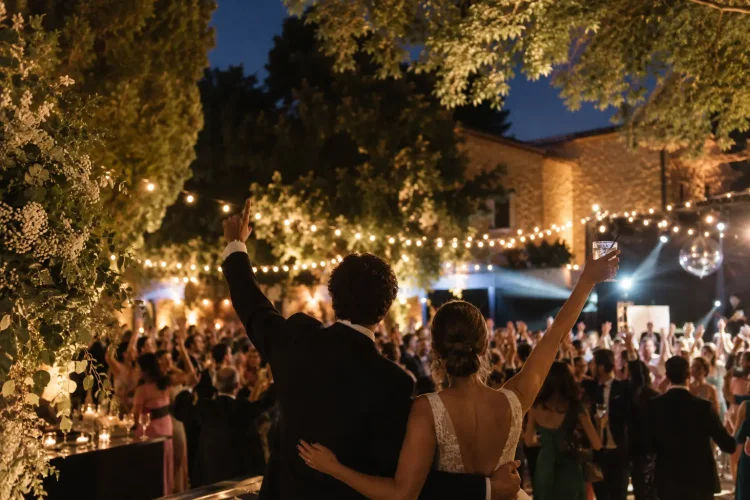
Imagine a wedding. During dinner, the entire space is lit up. The bride and groom arrive on the dance floor, and, little by little, some of that light fades away. The dance floor takes center stage. The music begins. And without anyone having to ask for attention, conversations stop and everyone’s gaze turns to the same spot. The interesting thing is that we haven’t necessarily made what we wanted to highlight any brighter.
We’ve simply made everything else less important.
And that difference completely changes the way we understand lighting.
It happens all the time at a concert.
Darkness: wait.
A beam of light on a person: look here.
A sudden change in color: something has changed.
The screens go dark: get ready.
Everything lights up all at once: now.
The audience may never consciously think about these cues. But they respond to them. And when sound, lighting, and video are perfectly coordinated, something fascinating happens: thousands of people can react practically at the same time without anyone having explained to them what they’re supposed to do.
More screens. More spotlights. More brightness. More movement. It may seem that the more stimuli an event has, the greater its impact will be. But there’s a problem:
if everything is trying to grab your attention, nothing ends up really holding your attention.
To create a great moment, you need contrast. There has to be darkness for the light to surprise you. Calm for a change to have impact. Silence for a burst of sound to make an impact. Spectacularity isn’t always about adding more. Often, it’s about knowing what to take away—and when to do it.
Don’t just look at the stage. Pay attention to yourself.
When did you stop talking? When did you turn your head? When did you know something was about to happen? When did you feel like you had to pull out your phone?
Some of those decisions may have been yours. But others likely began much earlier—at a lighting console, in video programming, or in the event’s audiovisual design.
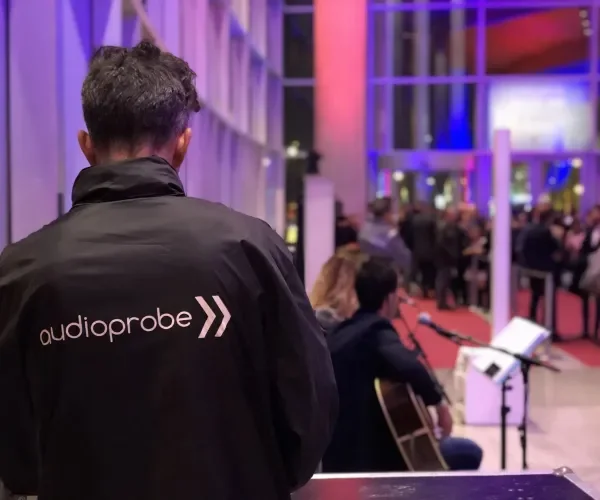
At Audioprobe, we work precisely on that aspect that often goes unnoticed: using sound, lighting, and video to create an experience that the audience doesn’t have to understand technically in order to feel it. Because perhaps one of the best signs that a show is well-designed is this: no one has to tell you where to look. You just look.